
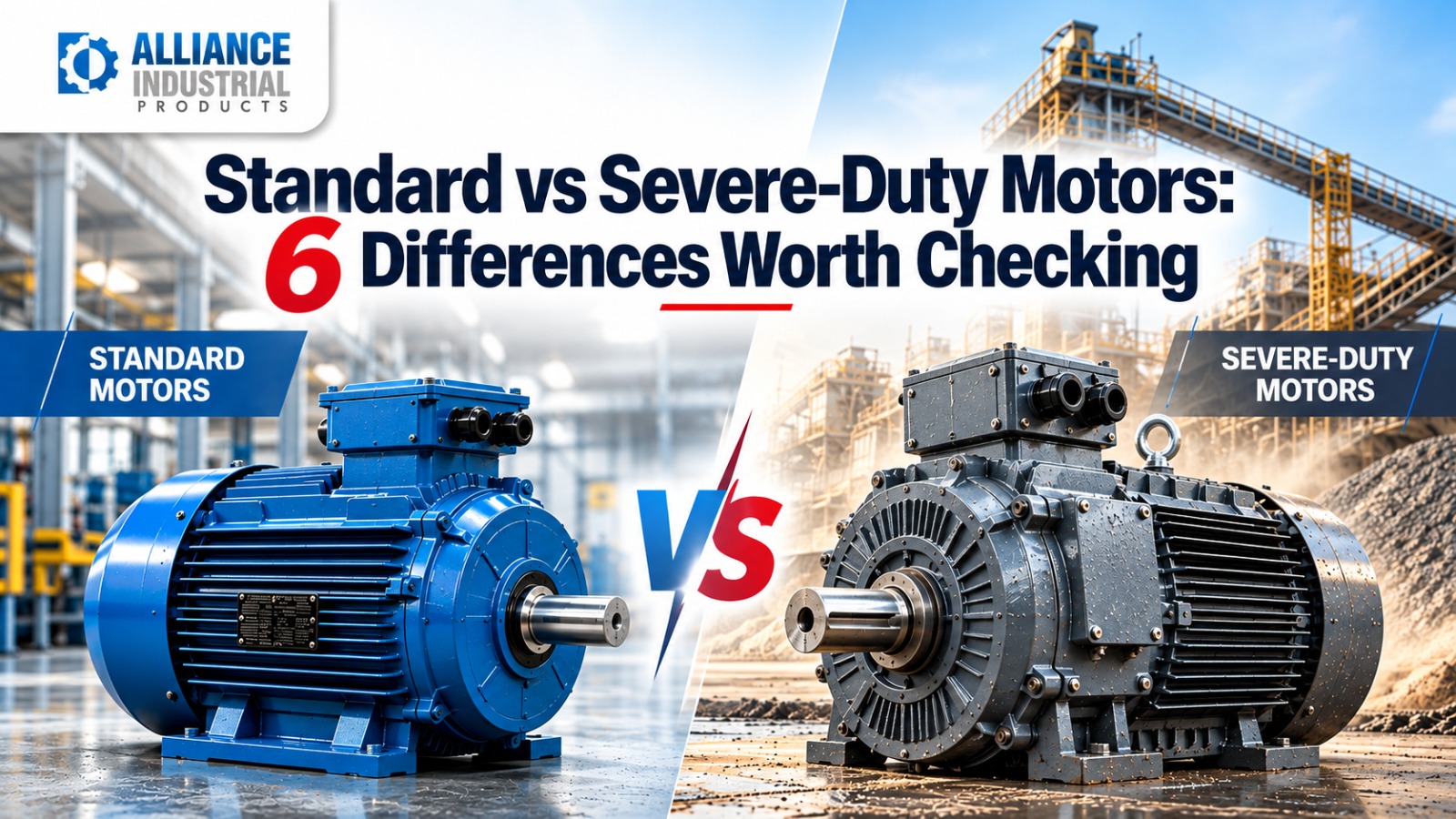
A motor can have the right kW rating, the right voltage and the right speed.
Yet, it can still be the wrong motor for the job.
Why?
Because the environment around a motor can matter almost as much as the load it drives.
That is where the severe duty motor vs standard motor decision becomes significant. A clean indoor plant and a wet, dusty processing area may demand very different construction, even when both applications need the same output power.
So, where does the difference actually matter?
Severe Duty Motor vs Standard Motor: It Starts With the Environment
A standard industrial motor generally suits normal service conditions where dust, moisture, corrosion and mechanical stress remain controlled.
A severe duty electric motor, meanwhile, adds protection for harsher operating conditions.
However, “severe duty” is not one universal specification. Construction varies by manufacturer and application. Therefore, the actual enclosure, materials, seals, insulation and service conditions should always be checked.
NEMA guidance also distinguishes usual from unusual service conditions and notes that severe environments can increase risks such as corrosion, insulation deterioration, overheating and mechanical failure.
What Actually Changes?
| AREA | STANDARD MOTOR | TYPICAL SEVERE-DUTY APPROACH |
| Environment | Clean, controlled areas | Dusty, wet, corrosive or outdoor areas |
| Frame | May use steel, aluminium or cast construction | Often heavier cast construction |
| Ingress protection | Selected for normal site needs | Often IP55 or higher, where required |
| Shaft protection | Standard sealing arrangement | Enhanced shaft seals may be specified |
| Corrosion resistance | Standard industrial finish | More robust coatings and hardware may be used |
| Bearings | Normal industrial arrangement | Extra protection may be specified for demanding duty |
| Typical use | HVAC, clean conveyors, indoor pumps | Mining, wastewater, marine, process and outdoor service |
Importantly, IP rating is only part of the story.
IEC 60034-5 classifies how a motor enclosure protects against contact, solid objects, dust and water. However, it does not by itself define protection against conditions such as corrosive vapour or condensation.
So, an IP55 label alone does not automatically make a motor suitable for every harsh environment.
1.) Moisture Changes the Decision
Consider an indoor fan motor first.
Now put the same motor beside an outdoor pump, cooling tower or wastewater process.
Suddenly, rain, washdown, humidity and condensation become part of the specification.
Therefore, motor selection for harsh environments should look at enclosure protection, sealing, drainage, terminal-box protection and corrosion resistance together.
2.) Dust Is More Than a Cleaning Problem
Dust can restrict cooling and contaminate internal components.
Moreover, some environments introduce abrasive particles that can accelerate wear around shafts, bearings and ventilation paths.
As a result, a motor working reliably in a clean plant may perform very differently in a mine, quarry or dusty process area.
This is where severe duty motor features can provide meaningful protection.
3.) Corrosion Can Attack From the Outside In
Coastal air, wastewater chemicals and industrial process vapours can challenge paint, fasteners, housings and other exposed surfaces.
Therefore, corrosion resistance deserves its own line in the specification.
Do not assume an enclosure rating covers it.
Instead, consider the atmosphere, coatings, materials and sealing arrangement.
4.) Heat Still Matters
A tougher housing does not remove thermal limits.
Motor loading, ambient temperature, ventilation and installation conditions still influence winding temperature and life.
IEC 60034-11, for example, covers thermal protection using temperature detectors and protectors incorporated into induction motors.
Meanwhile, current IEC efficiency classifications cover a broad range of line-operated AC motors up to 1,000 kW within the standard’s defined scope.
So, good industrial electric motor selection needs both environmental and electrical thinking.
5.) Vibration and Mechanical Duty Matter Too
Some motors operate beside crushers, conveyors, pumps or heavy process equipment.
Consequently, vibration, shaft loading, alignment and mounting become important.
A stronger enclosure alone will not solve poor alignment or excessive driven-load forces.
However, in the right application, more robust construction can improve reliability.
Where Severe Duty Starts Making Sense
Typical severe duty motor applications can include:
- Mining and mineral processing
- Wastewater and sewage plants
- Outdoor pumping systems
- Coastal and marine environments
- Heavy process plants
- Dusty material-handling areas
- Corrosive industrial locations
By contrast, general-purpose industrial motor types remain entirely appropriate when operating conditions stay within their intended service limits.
Choosing severe duty everywhere can add unnecessary specification and cost.
Choosing standard duty everywhere can create a very different cost: downtime.
A Better Selection Checklist
Before specifying heavy duty industrial motors, ask:
Environment: Is there dust, moisture, salt or corrosive material?
Electrical supply: What voltage, frequency and starting method apply?
Load: What torque, power and duty cycle does the machine require?
Temperature: What is the real ambient condition around the motor?
Drive: Will the motor operate on a VFD?
Protection: What IP rating, sealing and thermal monitoring are actually required?
The same systems thinking applies elsewhere in a plant. For example, our article on Solenoid Valves in Sugar Plants: Applications, Uses & Benefits shows how the operating environment influences component selection in sugar processing too.
Specify the Motor for the Place It Will Actually Work
At Alliance Industrial Products, our motor range includes low-voltage, high-voltage, severe-duty and DC solutions for a wide range of industrial requirements.
Our severe-duty range includes options from 160 kW to 1,000 kW at 380 to 690 V, 50 Hz, subject to the required specification and availability.
So, if the application conditions are difficult to define, talk to us before treating power rating as the whole specification. We can support sourcing through our global manufacturer network and help match the requirement to the appropriate motor solution.
Ultimately, the severe duty motor vs standard motor question is not about which motor is “better”.
It is about where the motor has to survive.
References & Further Reading
International Electrotechnical Commission, IEC 60034-5:2020: Rotating Electrical Machines, Part 5: Degrees of Protection Provided by the Integral Design of Rotating Electrical Machines.
International Electrotechnical Commission, IEC 60034-1:2026: Rotating Electrical Machines, Part 1: Rating and Performance.
International Electrotechnical Commission, IEC 60034-11:2020: Rotating Electrical Machines, Part 11: Thermal Protection.
U.S. Department of Energy: Motor Systems Technical Publications and Guidance. Covers motor selection, efficiency, maintenance, alignment and drive-system performance.
National Electrical Manufacturers Association, ANSI/NEMA MG 1: Motors and Generators. Includes guidance on motor service conditions, application and selection.
Frequently Asked Questions
1. Is a severe-duty motor always IP55?
No. IP55 or higher is common in many severe-duty specifications, but the required rating depends on the application and selected motor.
2. Can I use a standard motor outdoors?
Possibly, if its enclosure, temperature rating, corrosion protection and other specifications suit the actual outdoor conditions.
3. Does IP55 mean corrosion-resistant?
No. IP ratings concern ingress protection. Corrosive atmospheres require separate consideration.
4. Are severe-duty motors more efficient?
Not automatically. Severe-duty construction and motor efficiency describe different characteristics. Check the stated efficiency class separately.
5. Do severe-duty motors need less maintenance?
Not necessarily. Robust construction can improve suitability for harsh service, but alignment, lubrication, cooling and routine inspection still matter.
6. When should I consider moving from standard to severe duty?
Consider it when moisture, dust, corrosion, outdoor exposure, vibration or other unusual service conditions exceed what the standard motor was designed to handle.

