
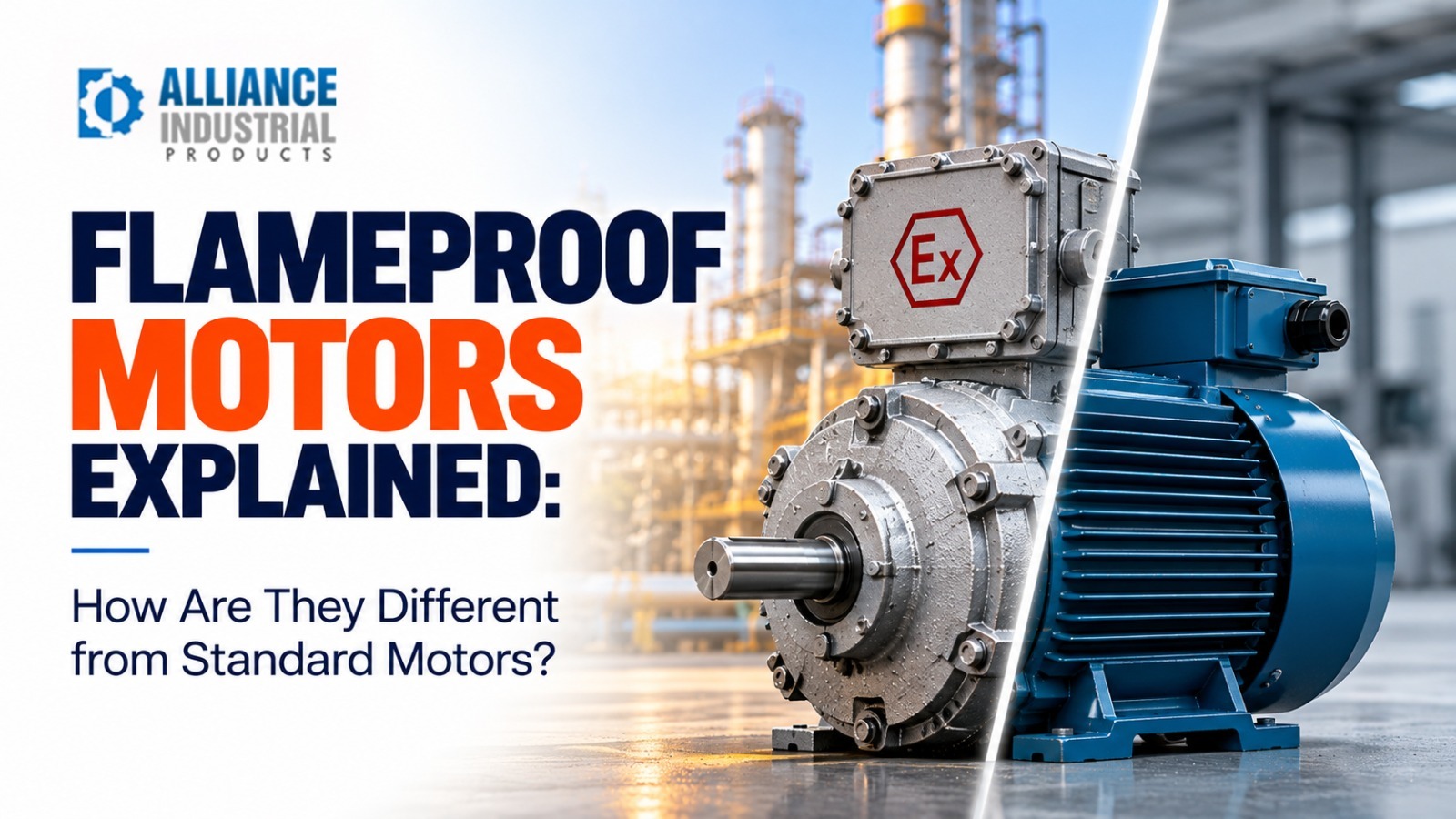
A standard motor can run perfectly well for years.
Put that same motor in the wrong hazardous area, though, and the question changes completely.
It is no longer only about power, efficiency or reliability.
It is about ignition risk.
That is why the flameproof motor vs standard motor comparison matters in industries where flammable gases or vapours may be present.
So, what actually makes a flameproof motor different?
Flameproof Motor vs Standard Motor: The Core Difference
A standard industrial motor is designed for ordinary operating environments.
A flameproof motor, however, uses a certified protection concept for explosive atmospheres.
Under IEC 60079-1, flameproof protection is known as Ex d. The enclosure must withstand an internal explosion and prevent it from igniting the surrounding explosive gas atmosphere.
That distinction is crucial.
A flameproof enclosure does not simply try to keep all gas outside.
Instead, it controls what happens if ignition occurs inside.
What Changes in the Motor?
| AREA | STANDARD INDUSTRIAL MOTOR | FLAMEPROOF MOTOR |
| Operating area | Ordinary industrial locations | Classified hazardous areas, where suitably certified |
| Enclosure | Designed for normal mechanical and environmental protection | Designed and tested to contain internal explosion pressure |
| Joints | Standard mechanical joints | Precisely controlled flame paths |
| Terminal box | Standard arrangement | Certified construction compatible with hazardous-area protection |
| Surface temperature | Governed by normal motor thermal limits | Must also suit the required temperature class |
| Certification | General motor standards | Requires applicable hazardous-area conformity |
| Selection basis | Power, speed, voltage, duty and environment | All of those, plus zone, gas group, temperature class and protection concept |
1. The Enclosure Has a Safety Function
First, consider the housing.
In a standard motor, the enclosure mainly protects internal parts and supports normal operation.
In a flameproof electric motor, the enclosure has another job.
It must maintain its integrity if an explosive mixture ignites inside it.
Therefore, housing strength, covers, fasteners, shafts and entries all become part of the certified design.
That is why simply placing a standard motor inside a heavier casing does not create a certified flameproof motor.
2. Flame Paths Are Engineered, Not Accidental
This is one of the most important differences.
Flameproof enclosures use carefully designed joints called flame paths.
If combustion gases pass through those joints after an internal ignition, the path restricts and cools them so the flame does not ignite the surrounding atmosphere.
IECEx identifies flame paths and enclosure integrity under pressure as core characteristics of Ex d protection.
Therefore, machining tolerances, joint dimensions and maintenance condition matter.
Damage, corrosion or unauthorised modification can compromise the protection concept.
3. Temperature Class Matters Too
Preventing flame propagation is only part of the job.
Hot surfaces can also become ignition sources.
Therefore, motors for hazardous areas need a temperature classification suitable for the gas or vapour present.
Under IECEx guidance, T1 permits a maximum surface temperature of 450°C, while T6 limits it to 85°C. The required class depends on the ignition characteristics of the surrounding substance.
So, selecting the right motor requires more than asking for “flameproof.”
4. Gas Group and Area Classification Matter
Next comes the surrounding atmosphere.
Gas hazards are grouped according to their ignition characteristics. IECEx divides Group II gas equipment into IIA, IIB and IIC subdivisions, while hazardous areas also require appropriate zone classification.
As a result, hazardous area motors must match the actual classified location.
A certificate alone is not enough if the motor’s gas group, temperature class or equipment protection level does not fit the site.
5. Certification Changes the Selection Process
This is another major difference.
In the European Union, ATEX Directive 2014/34/EU applies to equipment intended for use in potentially explosive atmospheres.
IECEx, meanwhile, provides an international certification system based on IEC standards for explosive atmospheres.
In India, BIS also maintains certification requirements based on IS/IEC 60079-1 for flameproof enclosures, including rotating electrical machines.
Therefore, industrial flameproof motors should always be selected against the applicable local regulations and project specification.
Also, an explosion proof motor in North American terminology should not automatically be treated as identical to an IEC Ex d motor. The approval system and marking requirements differ.
Where Are Flameproof Motors Commonly Used?
Typical flameproof motor applications can include:
- Oil and gas facilities
- Refineries
- Petrochemical plants
- Chemical processing
- Paint and solvent handling
- Fuel storage and transfer
- Certain mining applications
- Process areas where flammable gases or vapours may occur
However, not every tough industrial environment is a hazardous location.
For example, mining can demand extremely rugged construction even where explosion protection is not the main requirement. Our article Why Mining Operations in South America Need Heavy-Duty Electric Motors explores that reliability side in more detail.
A Better Selection Checklist
Before specifying hazardous location electric motors, confirm:
Area classification: What zone or classification applies?
Gas group: IIA, IIB or IIC?
Temperature class: What maximum surface temperature is permitted?
Protection concept: Is Ex d required, or another method?
Electrical duty: What power, voltage, speed and starting method apply?
Environment: Are corrosion, dust, moisture or outdoor exposure also concerns?
Certification: Which local and project approvals are required?
Safety Starts With the Specification
At Alliance Industrial Products, we supply low-voltage and high-voltage explosion and flameproof motor solutions for demanding industrial requirements.
Our available range includes LV units from 25 kW to 1,000 kW at 230 to 690 V, as well as HV options from 150 kW to 7,500 kW at up to 11 kV, subject to required certification and specification.
So, if your application involves a classified hazardous area, talk to us before selecting by kW and voltage alone.
We can support sourcing through our global manufacturer network and help match the motor specification to the actual application requirement.
Ultimately, the flameproof motor vs standard motor question is not about which motor is stronger.
It is about whether the motor is designed, tested and certified for the atmosphere around it.
References & Further Reading
International Electrotechnical Commission, IEC 60079-1: Explosive Atmospheres, Part 1: Equipment Protection by Flameproof Enclosures “d”. Defines construction and testing requirements for flameproof equipment.
IECEx: Standards Used in the IECEx Certified Equipment Scheme. Includes IEC 60079-0, IEC 60079-1, hazardous-area classification, installation and maintenance standards.
IECEx: Guidance on Ex protection techniques, including enclosure strength, flame paths, gas groups and temperature classes.
European Union: Directive 2014/34/EU, ATEX. Covers equipment and protective systems intended for potentially explosive atmospheres.
Bureau of Indian Standards: IS/IEC 60079-1 Product Manual. Covers certification practice for flameproof enclosures, including rotating electrical machines.
Frequently Asked Questions
1. What is a flameproof motor?
It is a motor using a certified protection concept, commonly Ex d under IEC standards, designed so an internal explosion does not ignite the surrounding explosive gas atmosphere.
2. Is a flameproof motor completely sealed?
Not necessarily. Ex d safety depends mainly on enclosure strength and controlled flame paths, not simply on preventing all gas entry.
3. Is flameproof the same as explosion proof?
The terms describe related safety goals, but certification systems and technical requirements differ between IEC, ATEX and North American frameworks.
4. Can a standard industrial motor be used in a hazardous area?
Only where the relevant area classification and regulations permit it. Equipment used in classified areas must match the identified hazard and required protection method.
5. What do IIA, IIB and IIC mean?
They are gas subdivisions used when selecting electrical equipment for explosive gas atmospheres. IIC represents gases requiring the most demanding equipment grouping within Group II.
6. Does IP rating make a motor flameproof?
No. IP ratings cover ingress protection against solids and water. Flameproof certification addresses explosion protection and requires separate construction, testing and marking.

