
In high-risk industrial environments, electrical equipment cannot afford to fail. A single spark in the wrong atmosphere can trigger catastrophic consequences. That is precisely where Explosion proof motors become critical.
Designed for operation in industrial hazardous locations where flammable gases, vapors, or combustible dust are present, these motors are engineered to contain internal ignition sources and prevent flame propagation into the surrounding environment.
Industries such as oil & gas, petrochemicals, mining, pharmaceuticals, and solvent processing rely heavily on these specialized drive systems.
Explosion Proof Motors: Understanding Protection Concepts
The terminology around hazardous area motors can seem complex. However, the core concepts are straightforward once broken down.
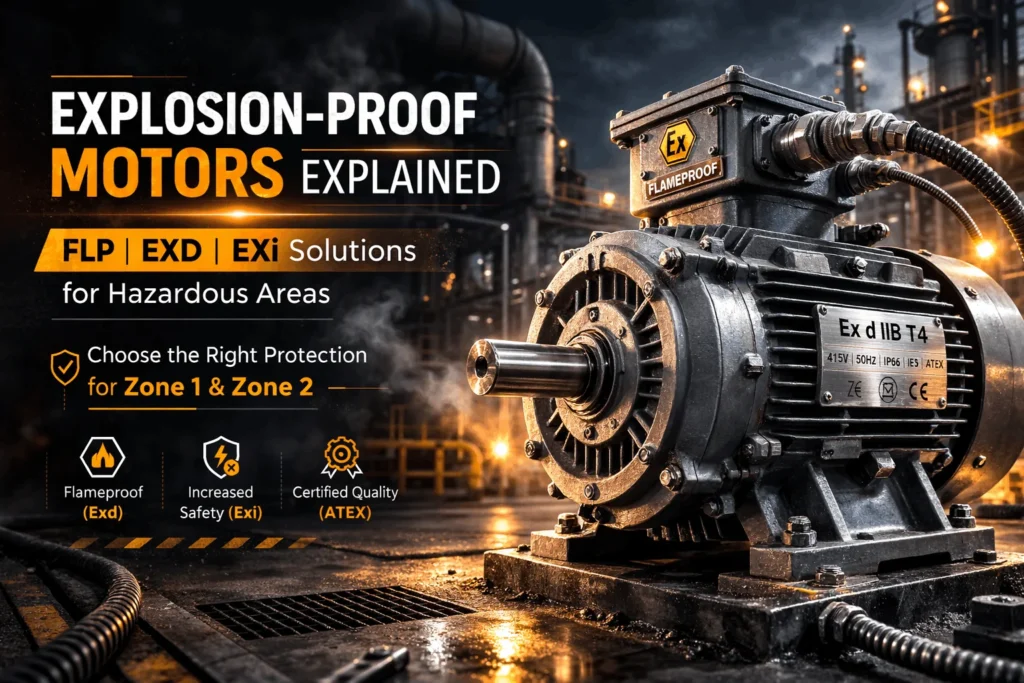
Flameproof Motor (Ex d)
A flameproof motor operates on the Ex d protection principle. In this design, the enclosure is strong enough to withstand an internal explosion. More importantly, it prevents the flame from escaping into the external atmosphere.
The carefully engineered flame paths cool escaping gases so that they cannot ignite the surrounding environment.
These motors typically comply with standards such as IS:60079-1 and IS:2148, and globally recognised frameworks like ATEX certified motors and IECEx certified motors.
Intrinsic Safety (Ex i)
Ex i systems focus on limiting electrical and thermal energy so ignition simply cannot occur. While commonly associated with instrumentation, Ex i concepts integrate into motor control circuits and protection systems within hazardous installations.
Both approaches serve specific operational needs depending on the zone classification.
Hazardous Area Classification & Compliance
Correct selection begins with understanding the site’s risk profile.
Zone 1 and Zone 2 Motors
Hazardous areas are classified based on the likelihood of explosive atmospheres being present.
- Zone 1: Explosive atmosphere likely during normal operation.
- Zone 2: Explosive atmosphere unlikely, but possible under abnormal conditions.
Zone 1 and Zone 2 motors must meet stringent enclosure and temperature requirements.
Gas Groups & Temperature Classes
Not all explosive gases behave the same way.
Explosion proof motors are designed for specific Gas group IIA IIB IIC classifications. IIC represents the most severe category, covering highly volatile gases like hydrogen.
Similarly, temperature limits are defined under Temperature class T1 to T6 standards. A T6 motor, for example, has a lower maximum surface temperature than T1, making it suitable for more sensitive environments.
Matching gas group and temperature class to site conditions is non-negotiable in hazardous engineering.
Technical Specifications & Build Strength
In demanding industrial hazardous locations, mechanical integrity is just as important as electrical compliance.
Most flameproof designs feature robust cast iron construction capable of containing internal pressure. Efficiency classes range from IE2 to IE4, supporting energy optimisation goals without compromising safety.
Typical specifications include:
- Power Range: 0.18 kW to 700 kW
- Voltage Options: 240V, 415V, 690V, dual or triple voltage
- Speeds: 2 to 14 poles (3000 RPM to 750 RPM)
- Mounting: B3 (foot), B5 (flange), B14 (face), or combinations
These configurations allow flexibility across pumps, compressors, fans, agitators, and mixers.
Read this: How Industrial Electric Motors Power Desalination Plants in Qatar
Motor Protection Systems & Accessories
Safety does not stop at enclosure design.
Advanced motor protection systems such as thermistors, RTDs, anti-condensation heaters, and specialised terminal boxes enhance operational reliability.
Additionally, certified explosion proof motor accessories play a critical role. These include:
- Flameproof cable glands
- Hazardous area junction boxes
- Breathers and drain plugs
- Encoders and feedback devices rated for explosive atmospheres
A compliant motor paired with non-compliant accessories creates system vulnerability. Engineering must consider the entire drive assembly.
Read this: Industrial Electric Motors for Cable Manufacturing in South Africa: Boost Efficiency & Reliability
Typical Industry Applications
Explosion proof motors are widely used in:
- Petroleum refineries
- Petrochemical complexes
- Paint and varnish manufacturing units
- Solvent extraction facilities
- Coal mining operations
They commonly drive centrifugal pumps, compressors, industrial blowers, and process mixers where ignition risk is inherent.
Sourcing & Compliance Assurance
Globally recognised manufacturers such as Crompton Greaves and Havells produce certified hazardous area motors within India. Alliance Industrial Products supplies these brands for projects requiring compliant and reliable drive solutions.
For procurement teams, certification traceability, proper documentation, and application alignment are essential. Selecting the correct motor is not only about power rating. It is about matching protection type, gas group, temperature class, and accessory configuration to site conditions.
Conclusion
In high-risk industrial hazardous locations, equipment selection is not a routine decision. It is a safety decision. Explosion proof motors must align precisely with zone classification, gas group, temperature class, and system-level protection requirements.
From flameproof motor configurations to certified accessories and integrated motor protection systems, every element must work together as a compliant unit. The margin for specification error in Zone 1 and Zone 2 environments is simply too small.
At Alliance Industrial Products, we support engineering and procurement teams with certified solutions from trusted Indian manufacturers such as Crompton Greaves and Havells.
If you are planning a hazardous area installation or upgrading existing equipment, connect with our team for specification guidance and compliant supply support.

