
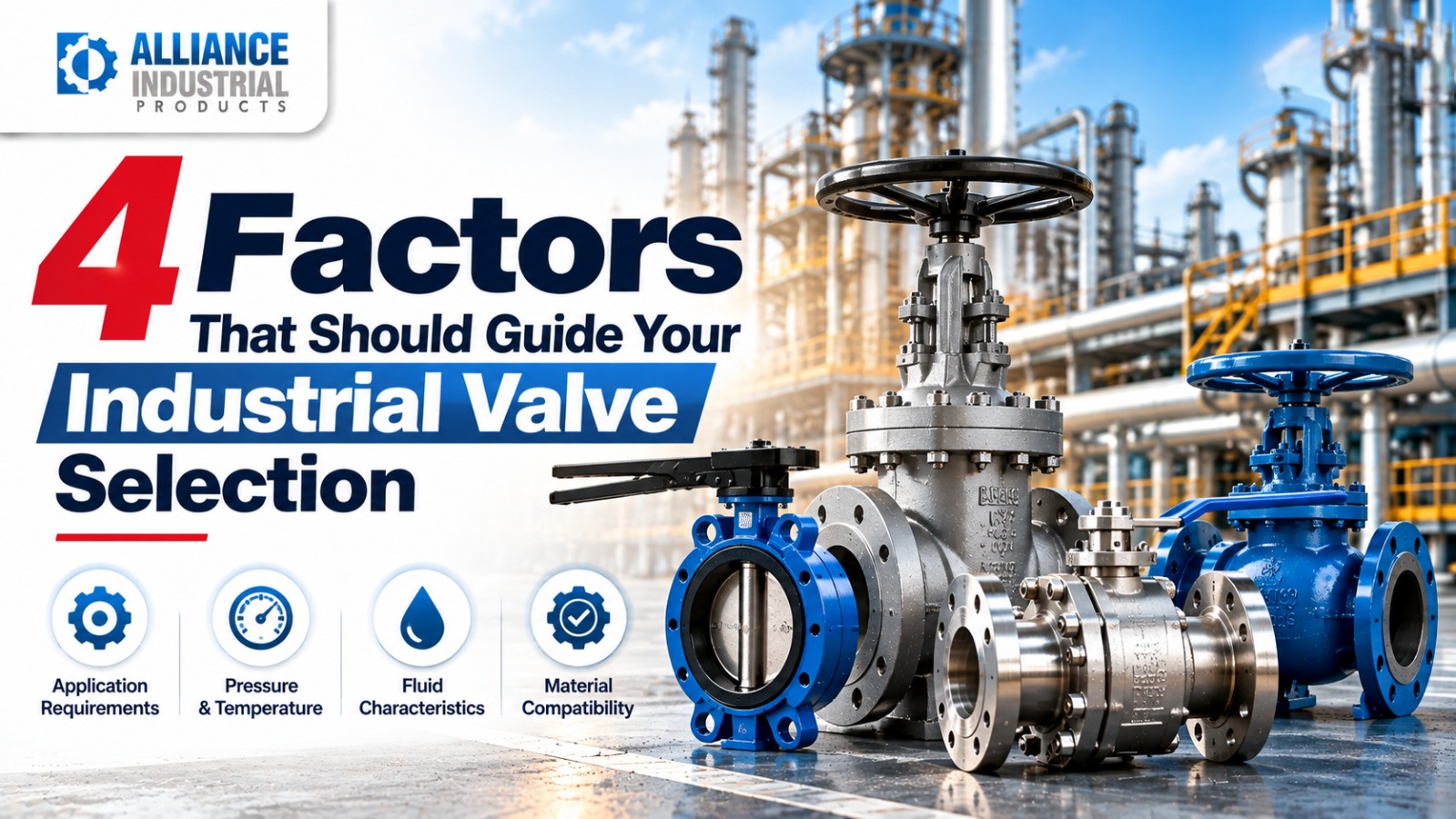
A valve fits the pipe.
The pressure class looks right.
The material sounds familiar.
So, is it the right valve?
Not necessarily.
Good industrial valve selection starts much earlier than choosing between a ball, butterfly, globe or gate valve.
First, you need to understand four things:
Pressure. Temperature. Fluid. Flow.
Get those right, and valve selection becomes much clearer.
Get one wrong, and the result may be leakage, poor control, rapid wear or an unnecessarily expensive valve.
Industrial Valve Selection Starts With Four Questions
| FACTOR | WHAT YOU NEED TO KNOW | WHAT IT INFLUENCES |
| Pressure | Maximum, minimum and differential pressure | Pressure class, body strength, actuator force |
| Temperature | Normal, maximum and minimum temperatures | Materials, seats, seals, pressure rating |
| Fluid | Chemistry, state, solids and abrasiveness | Body, trim, lining and seal compatibility |
| Flow | Required rate and control range | Valve size, type and Cv |
These are not four separate checks.
They interact.
That is why the best valve selection criteria consider them together.
1.) Pressure: What Must the Valve Withstand?
Start with the actual process pressure, not just the normal operating figure.
Ask:
- What is the maximum operating pressure?
- Can pressure surge?
- What pressure drop occurs across the valve?
- Does the valve need to shut off against full differential pressure?
Pressure affects the valve body, trim, seat and actuator.
Moreover, valve pressure capability can change with temperature.
ASME B16.34 covers pressure-temperature ratings, materials, testing and marking for many types of industrial valves.
Therefore, valve selection based on pressure and temperature should always use the applicable rating data rather than a pressure number in isolation.
2.) Temperature: More Than Just “Hot” or “Cold”
Temperature can change how almost every part of a valve behaves.
For example, seals and soft seats have operating limits. Metals expand. Lubricants behave differently. Meanwhile, the fluid itself may change viscosity or phase.
At higher temperatures, the allowable working pressure of some valve materials can also decrease.
So, always consider:
Process temperature + design temperature + ambient conditions
And do not forget low temperatures.
Cryogenic service can create its own challenges for materials, seals and bonnet design.
In short, temperature affects both mechanical strength and sealing performance.
3.) Fluid: What Is Actually Passing Through It?
This is where valve material selection becomes critical.
Water, steam, oil, gas, acid and slurry can all require different approaches.
So, before choosing a valve, identify:
State: Liquid, gas, vapour or multiphase?
Chemistry: Is the media corrosive?
Solids: Does it contain suspended particles?
Viscosity: Is it thin like water or much thicker?
Hazard: Is it toxic, flammable or otherwise dangerous?
For example, abrasive slurry can rapidly wear surfaces that work well with clean water.
Likewise, a chemically aggressive fluid can attack an otherwise strong valve body or seat.
That is why valve selection for different fluids should consider the body, trim, seats, packing and seals, not just the main body material.
4.) Flow: How Much, and How Must You Control It?
This is often where valve sizing gets misunderstood.
A DN100 pipe does not automatically need a DN100 control valve.
For control applications, engineers also look at required flow capacity and pressure drop.
The flow coefficient, commonly expressed as Cv, helps describe how much flow a valve can pass under defined conditions.
ISA develops the ISA-75 standards for control-valve sizing, selection, testing and performance. Its ISA75.01 work specifically addresses equations for sizing valves under installed flow conditions.
Therefore, good flow control valve selection should consider more than nominal pipe diameter.
An oversized control valve may operate too close to its seat for much of the time. That can make control less stable.
An undersized valve, meanwhile, may create excessive pressure drop or fail to provide the required capacity.
The Valve Type Comes After the Process
Once those four factors are clear, the valve design becomes easier to narrow down.
Ball Valve
Useful for fast, reliable on-off isolation with relatively low flow resistance.
Butterfly Valve
Often attractive for larger pipe sizes and high-flow applications where compact construction matters.
Globe Valve
Well suited to throttling and modulating control because its geometry provides useful control characteristics.
Gate Valve
Commonly used for isolation where the valve normally operates fully open or fully closed.
Check Valve
Prevents reverse flow rather than providing active throttling.
This is why understanding industrial valve types and applications matters.
A valve that is excellent at isolation may be a poor choice for continuous throttling.
One More Risk: Pressure Drop Can Change the Fluid
For liquid services, a large pressure drop can create another problem.
If local pressure falls below the liquid’s vapour pressure, vapour bubbles may form.
If those bubbles later collapse, cavitation can result.
If the downstream pressure remains below vapour pressure, flashing may continue downstream.
Therefore, difficult control applications need more than a quick Cv calculation.
Pressure, temperature and fluid properties have to be considered together.
A Practical Selection Sequence
If you are wondering how to select an industrial valve, use this order:
1. Define the fluid
What exactly is moving through the line?
2. Establish pressure and temperature limits
Use worst-case design conditions, not just normal operation.
3. Determine required flow
Include minimum, normal and maximum flow where relevant.
4. Define the valve’s job
Isolation, throttling, non-return, diverting or another function?
5. Select compatible materials
Check body, trim, seat, seals and packing.
6. Size and verify
Confirm pressure class, Cv, velocity, actuator requirements and applicable standards.
This approach turns an industrial valve selection guide into an engineering process rather than a catalogue exercise.
The same application-first thinking matters with specialised valves too. Our article on Solenoid Valves in Sugar Plants: Applications, Uses & Benefits shows how process conditions can shape valve choice in sugar production.
Start With the Process, Then Choose the Valve
At Alliance Industrial Products, we supply a broad range of industrial valves for isolation, flow control and demanding process applications.
Through our global manufacturer network, we can also support customers with product sourcing based on application, material, pressure and flow requirements.
So, if a valve specification involves unusual media, high pressure, challenging temperature or difficult flow conditions, talk to us before choosing by size alone.
Ultimately, good industrial valve selection comes down to four questions:
What pressure? What temperature? What fluid? What flow?
Answer those first.
Then choose the valve.
References & Further Reading
ASME B16.34:2025, Valves, Flanged, Threaded and Welding End. Covers pressure-temperature ratings, materials, dimensions, testing and marking for applicable industrial valves.
ASME, Selection and Application of Valves. Covers pressure-temperature ratings, valve construction materials and material compatibility within the ASME B16 framework.
International Society of Automation, ISA-75 Series. Official standards covering control-valve design, sizing, testing, terminology and performance.
ISA75.01, Control Valve Sizing Equations. Covers standardisation of control-valve flow sizing under installed process conditions.
American Petroleum Institute, Valve Standards. API’s standards programme includes specifications covering gate, globe, check, plug and ball valves as well as valve inspection and testing.
Frequently Asked Questions
1. What is the most important factor when selecting a valve?
There is no single factor. Pressure, temperature, fluid compatibility, flow and valve function all need to work together.
2. Can I choose a valve based only on pipe size?
No. Pipe size is only one input. Flow requirement, pressure drop, Cv and valve function can affect the required valve size.
3. Does a higher pressure class always mean a better valve?
No. The correct class should suit the design pressure, temperature, material and applicable piping standard.
4. Why does fluid compatibility matter?
The media can attack body materials, trim, seals or seats. Abrasive fluids can also accelerate mechanical wear.
5. Which valve is best for throttling?
Globe valves are commonly used for control, but the best choice depends on flow, pressure drop, rangeability, fluid properties and service conditions.
6. What is Cv in valve sizing?
Cv is a flow coefficient used to express valve flow capacity under defined conditions. It is an important input when sizing control valves.

