
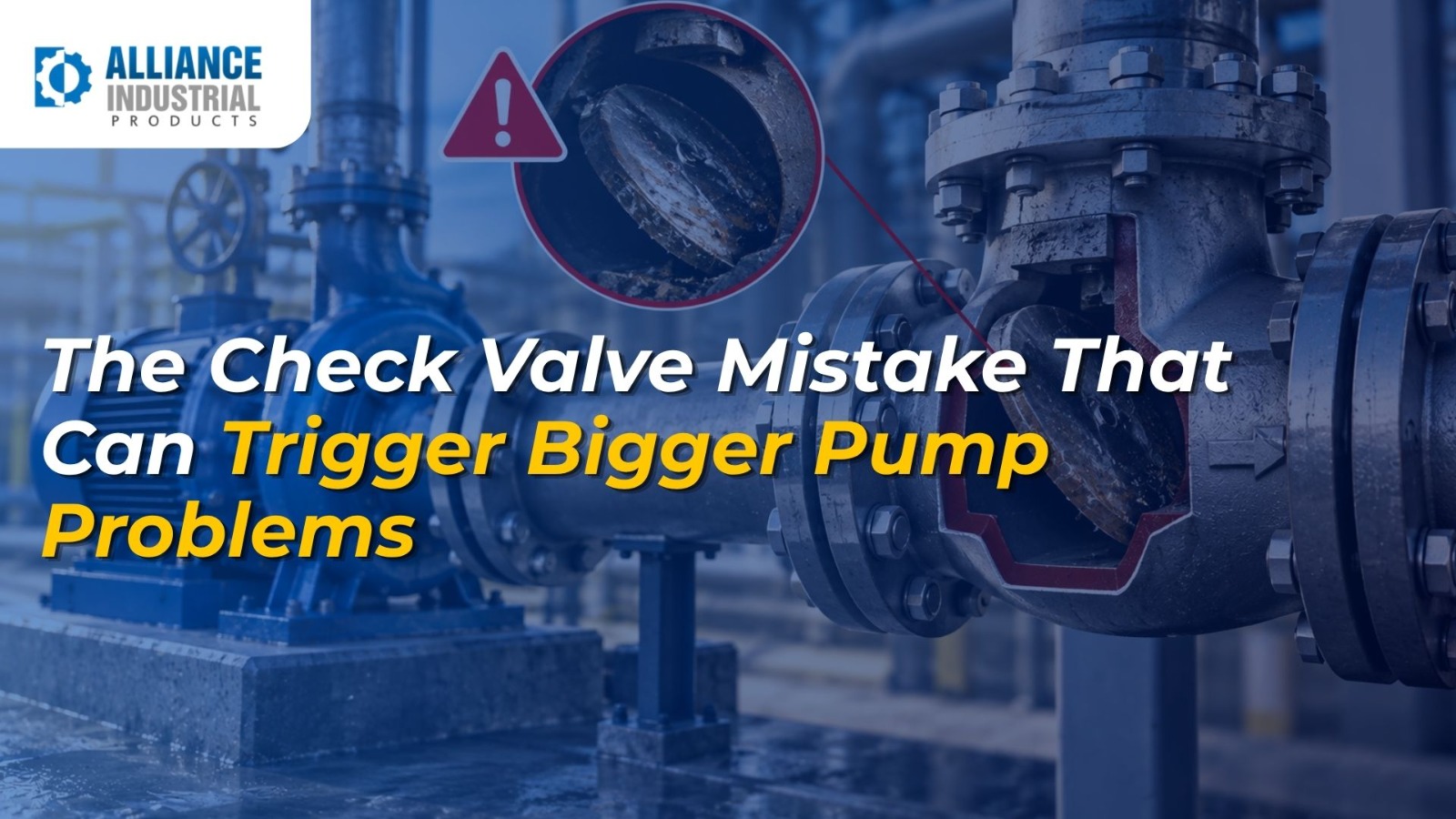
A check valve has a fairly simple job.
Let fluid move in one direction. Stop it from coming back.
So why can such a small component cause such a big headache?
The answer often comes down to something engineers know well: the right valve for the wrong application can still become a problem.
Non-Return Check Valves are used across pumping and piping systems to prevent reverse flow. But the wrong valve type, sizing, installation or operating conditions can lead to pressure surges, vibration, leakage and premature wear.
And sometimes, the warning signs are surprisingly easy to miss.
First, What Does a Check Valve Actually Do?
A check valve allows fluid to move forward through a pipeline while restricting flow in the opposite direction.
One common application is on the discharge side of a pump.
When the pump runs, the valve opens with the flow. When the pump stops, the valve closes to help prevent fluid from flowing back through the pump. EPA guidance specifically identifies check valves as a means of preventing backflow through pumps.
Simple enough.
But the way that valve opens and closes matters.
A lot.
The Problem Starts When Flow Stops
Imagine a pump pushing water through a long pipeline.
Everything is moving normally.
Then the pump stops.
The fluid does not instantly stop moving. It has momentum.
If the check valve closes at the wrong moment or too abruptly, that moving fluid can create a sudden pressure change.
That is water hammer, also called a pressure surge.
The result can include:
- Pressure spikes
- Vibration and noise
- Pipe and fitting stress
- Damage to valves
- Increased wear on pumps
- Repeated maintenance issues
EPA guidance warns that a check valve that slams open or shut can contribute to pressure surge or water hammer.
So, a valve that successfully stops backflow can still create another problem if its closing behaviour does not suit the system.
What Happens When the Valve Is Wrong?
Here are some common warning signs:
1.) The valve keeps slamming
A noisy closure can indicate a valve that is not responding well to the flow conditions.
And that repeated impact can increase mechanical wear.
2.) The system experiences pressure spikes
A fast change in flow can create a pressure surge. In long pipelines especially, that can become a serious design consideration.
Wastewater design criteria, for example, call for surge conditions caused by sudden pump stops and check valve closure to be considered in force-main design.
3.) The pump sees reverse flow
If the valve does not close properly, fluid can travel back towards the pump.
That defeats the main purpose of the valve and can also affect pump operation.
4.) The valve creates unnecessary pressure loss
Every valve introduces some resistance to flow.
If the design creates excessive pressure loss, the pumping system may have to work harder to achieve the required duty.
5.) Maintenance keeps coming back
A check valve that repeatedly sticks, leaks, slams or wears out is telling you something.
Replacing the same component again and again may treat the symptom without addressing the selection or operating conditions behind it.
The Hidden Part of Check Valve Selection
This is where procurement can get interesting.
A valve may look perfect on paper.
Correct size.
Correct pressure rating.
Correct connection.
Competitive price.
Done?
Not quite.
You also need to consider:
a) Flow velocity
How quickly is fluid moving through the system?
b) Pressure and temperature
What conditions will the valve actually experience?
c) Fluid characteristics
Is the fluid clean, abrasive, corrosive or carrying solids?
d) Installation position
Some valve designs have specific orientation requirements.
e) Pump behaviour
How quickly does the pump start and stop?
f) Reverse-flow risk
How much backflow can the system tolerate?
g) Maintenance access
Can the valve be inspected or serviced without creating a major shutdown?
These details can change which valve design makes sense.
This Matters Even More Around Pumps
Check valves and pumps work as a system.
For example, a pump station may use a check valve on the discharge side specifically to prevent backflow when the pump stops. EPA wastewater guidance describes this arrangement in lift stations.
That means the valve’s behaviour during pump startup and shutdown deserves attention.
A valve that works perfectly under steady flow may behave differently during rapid changes.
And that is precisely why check valve selection should happen alongside pump and piping design, rather than as an afterthought.
What Should You Look For in Industrial Check Valves?
Before choosing an industrial check valve, look beyond the basic size and pressure rating.
Ask:
- What is the normal flow rate?
- What is the expected flow velocity?
- What happens when the pump stops?
- Is water hammer a concern?
- What pressure drop can the system tolerate?
- What is the fluid carrying?
- How frequently will the valve cycle?
- What maintenance access is available?
Then select the valve design around those conditions.
That approach can prevent a surprisingly common mistake: buying a valve because it fits the specification sheet, only to discover that it does not behave well in the actual system.
Where Alliance Industrial Products Fits In
At Alliance Industrial Products, we look beyond simply matching a valve size to a pipe.
We help customers assess the application and identify suitable industrial valve options based on operating requirements.
Our range includes check valves and other industrial flow-control components, backed by ready-stock availability for selected products, fast response and 24×7 service support.
We also supply original equipment from approved global manufacturers, with competitive pricing aligned with the global industrial market.
Because the cheapest valve on the purchase order can become an expensive valve once maintenance, downtime and replacement enter the picture.
A Small Valve Can Protect a Big System
The humble check valve rarely gets much attention.
Until something goes wrong.
Then suddenly, backflow, pressure surges, vibration and pump problems become everyone’s concern.
That is why Non-Return Check Valves deserve more thought than simply checking their size and pressure rating.
Choose the design around the fluid.
Match it to the flow conditions.
Consider how the system starts and stops.
And, most importantly, look at the valve as part of the entire pumping system.
At Alliance Industrial Products, we can help you evaluate the application and select the right valve for the operating conditions, with access to original equipment, ready-stock options and responsive technical support.
Because sometimes the smallest valve in the pipeline is doing one of the biggest jobs.
FREQUENTLY ASKED QUESTIONS
1. What is the purpose of a non-return check valve?
It allows flow in one direction and helps prevent reverse flow through a pipeline, pump or other equipment.
2. What causes a check valve to fail?
Common causes include incorrect sizing, unsuitable valve design, excessive cycling, debris, wear, corrosion and operating conditions outside the valve’s intended range.
3. Can a check valve cause water hammer?
Yes. Rapid or poorly controlled valve closure can contribute to pressure surges and water hammer.
4. Which type of check valve should I use?
It depends on the flow, pressure, fluid characteristics, installation and pump operating conditions. Swing, ball, lift and dual-plate designs each have different characteristics.
5. Where are check valves commonly used?
They are widely used on pump discharge lines, water and wastewater systems, industrial pipelines and other applications where reverse flow needs to be controlled.

