
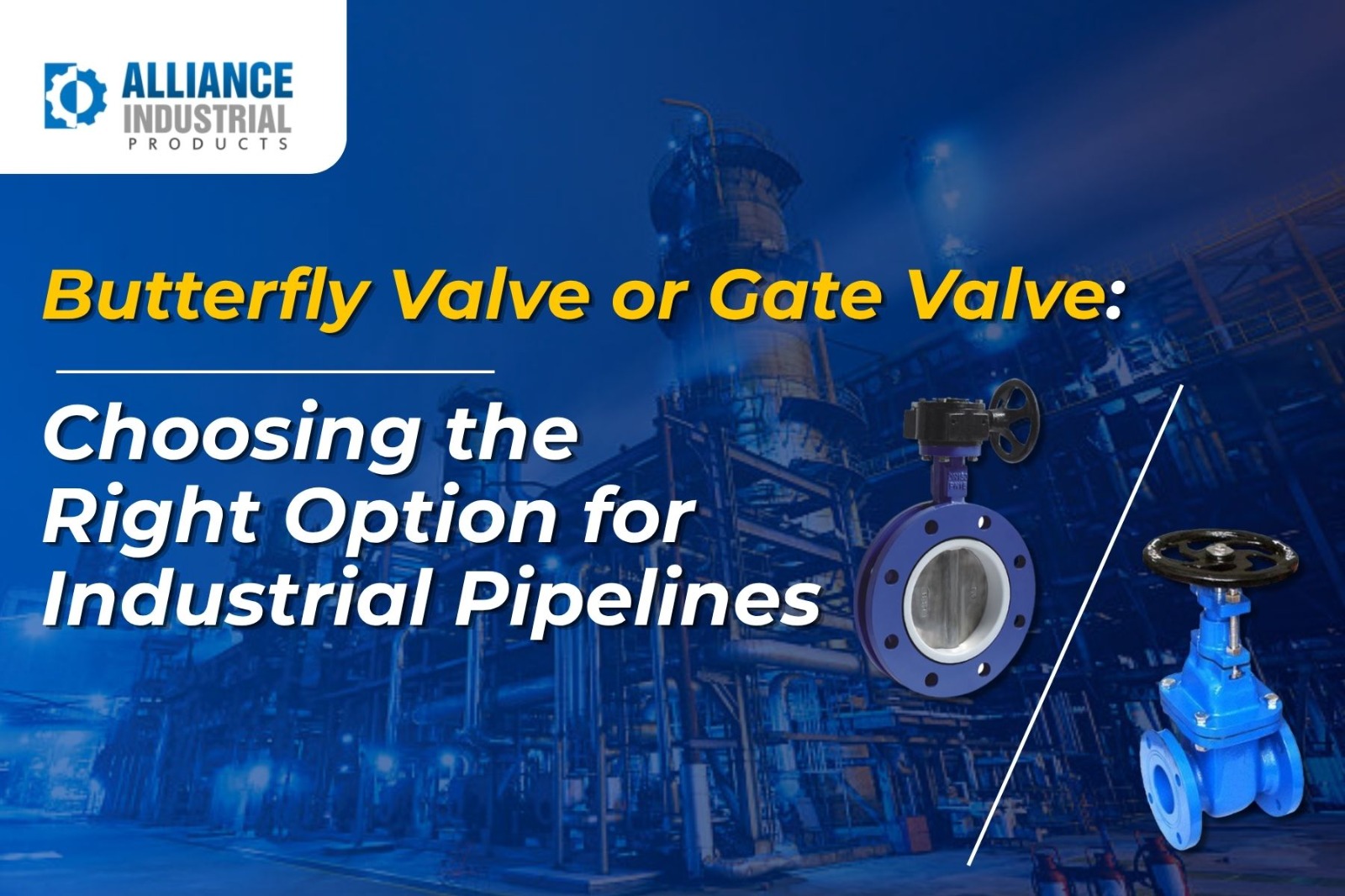
Choosing a valve sounds straightforward until you realise how much depends on getting it right. The wrong choice can affect flow efficiency, maintenance schedules, installation costs, and even the lifespan of your pipeline system.
That is why the Butterfly Valve vs Gate Valve discussion comes up so often in industries such as water treatment, chemical processing, mining, power generation, oil and gas, and manufacturing.
The truth is, there is no universal winner. Instead, the better option depends on what your pipeline needs to achieve. This guide breaks down the key differences, helping you make a more informed decision.
Butterfly Valve vs Gate Valve: A Quick Side-by-Side Comparison
| FEATURE | BUTTERFLY VALVE | GATE VALVE |
| Operation | Quarter-turn disc | Linear-moving gate |
| Best for | Flow isolation and flow regulation | Full open or full closed isolation |
| Operating Speed | Fast | Slower |
| Space Required | Compact | Larger installation space |
| Pressure Drop | Slightly higher | Very low when fully open |
| Weight | Lightweight | Heavier |
| Maintenance | Generally simpler | May require more maintenance depending on service |
| Larger Pipe Sizes | Cost-effective | Usually more expensive |
If you’re after a quick answer, butterfly valves often suit applications where space, speed, and cost matter. Meanwhile, gate valves remain a strong choice for applications requiring unrestricted flow when fully open.
How Does a Butterfly Valve Work?
A butterfly valve uses a circular disc mounted on a rotating shaft.
Turning the handle or actuator by 90 degrees rotates the disc, allowing or stopping flow almost instantly.
Because of this simple design, butterfly valves offer several advantages:
- Compact installation
- Lightweight construction
- Fast quarter-turn operation
- Lower installation costs
- Suitable for manual or automated systems
These features make butterfly valves particularly popular for large-diameter piping systems where reducing weight and installation space is important.
They are also commonly used where operators need to open and close valves frequently.
How Does a Gate Valve Work?
A gate valve operates differently.
Instead of rotating a disc, it raises or lowers a gate inside the valve body using a threaded stem.
When fully open, the gate moves completely out of the flow path. As a result, the fluid experiences minimal resistance.
This makes gate valves ideal for applications where unrestricted flow is important.
Typical advantages include:
- Very low pressure loss
- Excellent shut-off capability
- Suitable for high-pressure systems
- Ideal for applications that remain fully open or fully closed
However, because the valve must travel a greater distance during operation, opening and closing usually takes longer than with a butterfly valve.
Butterfly Valve vs Gate Valve: Which Performs Better in Different Situations?
Rather than asking which valve is better overall, it is more useful to ask which valve performs better for a particular application.
Choose a Butterfly Valve When…
✔ Installation space is limited.
✔ Fast opening and closing are important.
✔ Weight reduction matters.
✔ Large pipeline diameters are involved.
✔ Cost efficiency is a priority.
Because butterfly valves are relatively compact, they often reduce installation complexity in modern industrial facilities.
Choose a Gate Valve When…
✔ Maximum flow capacity is required.
✔ Pressure loss must remain as low as possible.
✔ The valve will normally stay fully open or fully closed.
✔ High-pressure service is involved.
Since the gate moves completely out of the flow path, it creates very little flow restriction when fully open.
Five Questions That Simplify Valve Selection
Instead of focusing only on valve types, ask these practical questions before making a decision.
1.) Will the valve operate frequently?
Frequent operation generally favours butterfly valves because they open and close quickly.
2.) Is installation space limited?
Compact equipment rooms often benefit from butterfly valves due to their smaller footprint.
3.) Does unrestricted flow matter?
If maintaining maximum flow is critical, a gate valve may be the better choice.
4.) What are the operating conditions?
Fluid type, pressure, temperature, and pipeline size all influence proper valve selection.
5.) Will the valve be automated?
Both valve types support electric or pneumatic actuators, although butterfly valves are commonly selected where frequent automated operation is required.
Where Each Valve Is Commonly Used
Although both belong to the family of industrial valves, their applications often differ.
Butterfly Valve Applications
- Water treatment plants
- HVAC systems
- Cooling water systems
- Chemical processing
- Food processing
- Fire protection systems
- Large distribution pipelines
Gate Valve Applications
- Oil and gas facilities
- Steam systems
- Water transmission lines
- Mining operations
- Power generation plants
- High-pressure process lines
Many industrial valve applications actually use both valve types within the same facility because each serves a different purpose.
A Common Mistake Buyers Make
One of the biggest misconceptions is assuming one valve can replace every other valve.
In reality, engineers evaluate several factors before specifying a valve, including:
- Operating pressure
- Temperature
- Media characteristics
- Required flow rate
- Maintenance accessibility
- Available installation space
- Frequency of operation
Looking at only the purchase price often leads to higher lifecycle costs.
Instead, selecting the right valve for the specific application usually delivers better long-term reliability and lower maintenance requirements.
Why the Supplier Is Just as Important as the Valve
Even the best-designed valve must match the application’s operating requirements.
An experienced industrial valve supplier can help identify the correct valve type, materials, pressure class, end connections, and actuation options for each project.
Alliance Industrial Products supplies a wide range of industrial valve solutions for demanding sectors including water treatment, oil and gas, chemical processing, power generation, manufacturing, and mining. By working directly with industrial end users, Alliance provides reliable products backed by technical expertise and international procurement support.
The Right Choice Depends on the Application
The Butterfly Valve vs Gate Valve debate does not have a one-size-fits-all answer. Both valve types offer proven performance, but they solve different engineering challenges.
If compact installation, fast operation, and lower weight are priorities, a butterfly valve is often the practical choice. On the other hand, if your system demands unrestricted flow and dependable isolation under higher pressures, a gate valve may be better suited.
Ultimately, understanding your operating conditions, performance requirements, and maintenance expectations will lead to a smarter decision. Pairing the right valve with the right application is the most effective way to improve reliability, efficiency, and long-term performance across your industrial pipelines.

