
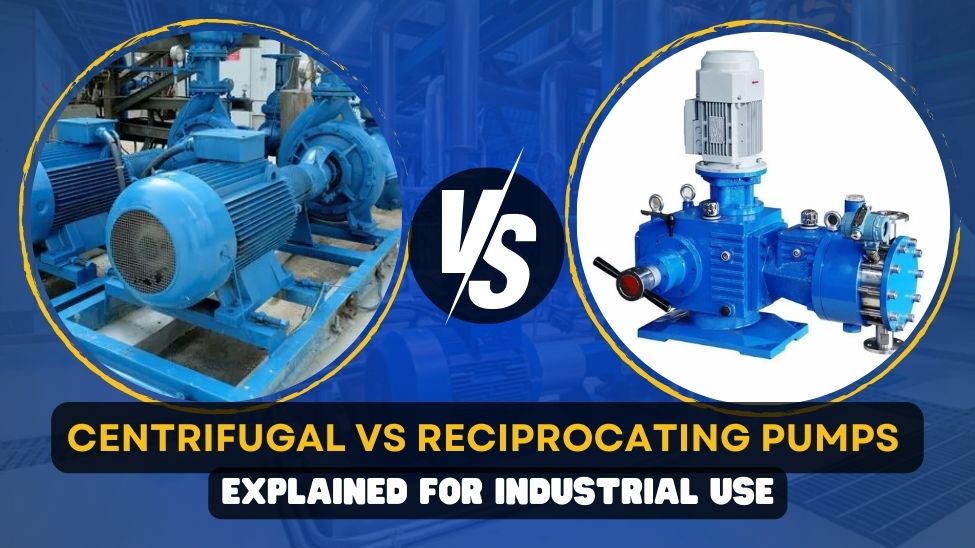
In industrial systems, the wrong pump selection choice can lead to unstable flow, excessive maintenance, wasted energy, or process downtime that nobody budgeted for. Among the most common comparisons engineers face is centrifugal vs reciprocating pump: two designs built for very different operating realities.
This blog breaks down centrifugal vs reciprocating pumps, focusing on how each performs in real industrial environments in industrial environments, where flow consistency, pressure demands, fluid properties, and maintenance practicality matter far more than theory.
Understanding Centrifugal vs Reciprocating Pumps
Before comparing applications, it helps to understand how each pump actually moves fluid.
Centrifugal Pump Working Principle
Centrifugal pumps use a rotating impeller to impart velocity to the fluid. That velocity is converted into pressure as the fluid exits the impeller and moves through the casing.
The result is:
- Continuous, smooth flow
- High flow rates
- Best performance with low-viscosity fluids
This simplicity is the reason centrifugal pumps dominate most industrial pumping systems.
Reciprocating Pump Working Principle
Reciprocating pumps move fluid using a piston, plunger, or diaphragm inside a cylinder. Fluid is drawn in and pushed out through check valves in a back-and-forth motion.
This creates:
- Pulsating flow
- Very high discharge pressure
- Precise volume control
The design is mechanically more complex but excels in specific high-pressure or dosing applications.
Key Differences at a Glance
The following comparison highlights the real-world differences in centrifugal vs reciprocating pumps across industrial operating conditions.
| Feature | Centrifugal Pump | Reciprocating Pump |
| Action | Continuous centrifugal force | Pulsating piston/plunger action |
| Flow | High volume, smooth | Low volume, pulsating |
| Pressure | Low to medium head | High head |
| Viscosity | Low viscosity fluids | Wide range, higher viscosity |
| Efficiency | Good for high flow | High efficiency at high pressure |
| Complexity | Simple, lower maintenance | Complex, higher maintenance |
| Priming | Requires priming | Self-priming |
This comparison highlights why industrial pump selection is less about “better” and more about operating conditions.
Centrifugal Pump Applications in Industry
Centrifugal pumps are the default choice in most industrial facilities, and for good reason. Their ability to move large volumes of fluid continuously with minimal mechanical complexity makes them ideal for processes that run nonstop.
Common centrifugal pump applications include:
- Water circulation and transfer
- Cooling and HVAC systems
- Desalination and water treatment plants
- Chemical processing with low-viscosity fluids
- Power plant auxiliary systems
- General-purpose industrial fluid movement
Their simple construction translates into:
- Lower maintenance requirements
- Easier spare part availability
- Better suitability for continuous-duty operation
In industries where uptime and reliability matter more than ultra-high pressure, centrifugal pumps tend to outperform alternatives in total lifecycle cost.
Reciprocating Pump Applications
Reciprocating pumps serve a narrower but critical role. They are selected when pressure and precision outweigh flow volume and simplicity.
Typical reciprocating pump applications include:
- High-pressure injection systems
- Chemical dosing and metering
- Handling viscous or shear-sensitive fluids
- Applications requiring accurate volume control
- Specialized process equipment
That said, these advantages come with trade-offs:
- Higher mechanical wear
- More frequent maintenance
- Pulsation dampening requirements
- Higher initial and operating complexity
For facilities without a clear need for high-pressure precision, these factors can become operational burdens over time.
Centrifugal vs Reciprocating Pump: When to Use Which Pump
Choosing between centrifugal and reciprocating pumps comes down to how the system behaves day after day and not just what looks good on paper.
a) Choose Centrifugal Pumps When:
- Large volumes of fluid must be moved continuously
- Flow smoothness is more important than precise dosing
- Fluids have low viscosity
- Lower maintenance and operational simplicity are priorities
- Systems operate for long durations with minimal interruption
b) Choose Reciprocating Pumps When:
- High pressure is non-negotiable
- Flow accuracy and dosing precision are critical
- Fluids are viscous or difficult to move
- The process can accommodate higher maintenance demands
In practice, most industrial operations lean toward centrifugal pumps because they align better with real-world requirements like scalability, reliability, and ease of operation.
Why Alliance Industrial Products
Alliance Industrial Products supports industrial operations worldwide with a strong focus on reliable, high-performance pumping solutions suited for demanding environments.
Global Presence: Delivering Excellence Across Continents
Alliance Industrial Products serves customers across Oman, UAE, Kenya, Kuwait, Australia, Nigeria, Philippines, South America, Egypt, Morocco, Brazil, Peru, Argentina, Saudi Arabia, Jordan, Latin America, Indonesia, Thailand, Sri Lanka, France, Germany, Vietnam, Uganda, and more.
Read This: Centrifugal Pump Supplier from India to Philippines
When You Partner with Alliance Industrial Products, You Gain:
- Access to a vast inventory of industrial-grade equipment
- Competitive pricing without compromising quality
- Fast turnaround for project-driven requirements
- Technical support from a team that understands industrial systems
Choosing the right pump is only half the equation. Having the right supply partner completes the system.
Making the Right Industrial Pump Selection
The difference between centrifugal vs reciprocating pumps is not just mechanical—it’s operational. One is built for flow and continuity, the other for pressure and precision. Understanding this distinction is key to avoiding over-engineered systems or unnecessary maintenance challenges.
For industries focused on long-term efficiency, consistent performance, and reduced downtime, centrifugal pumps remain the most widely adopted and trusted solution.

