

Leading Industrial Valve Suppliers in India deliver top-quality valves designed to meet the unique demands of various industries.
As one of the top industrial valve manufacturers in India, Alliance Industrial Products provides a wide range of high-quality valves designed for various industries.
Therefore, selecting the right valve is important for achieving optimal system performance and longevity. With multiple factors to consider, making an informed choice can seem complex.
In this guide I will tell you what are the types of Industrial valves and there applications and also know that the valve selection criteria which is perfect for your industry needs, and lets break it down:
Types of Industrial Valves and Their Applications:
1. Pulp Stock Valves:
Designed for handling thick and fibrous materials, pulp stock valves are widely used in industries such as sugar, paper, and chemicals. Their robust construction allows them to manage high-viscosity fluids efficiently.
- Size: 50mm to 500mm
- Material: Cast Steel, Bronze, Stainless Steel, MS Fabricated
- Application: Ensures smooth flow of pulp and fibrous materials while minimizing blockages.
2. Double Beat Valves:
Double beat valves are specialized for controlling fluid flow in sugar factories, particularly in juice heaters. These valves are built with precision to handle high-temperature fluids effectively.
- Size: 125mm to 300mm
- Material: Cast Iron, Cast Steel, MS or SS Fabricated with Stainless Steel, Rubber, Leaded Tin Bronze internals
- Options: Various sealing materials, including EPDM, Silicone, Viton rubber, and Teflon.
3. Sluice Valves:
Primarily used in water supply and industrial piping systems, sluice valves provide low-pressure drop and are suited for both clean and turbid water applications.
- Size: 50mm to 1200mm
- Material: Cast Iron, Cast Steel, MS Fabricated, Ductile Iron
- Application: Water supply networks, boiler lines, and industrial fluid management.
- Accessories: Gear options, travel indicators, back seating, and actuator compatibility.
4. Non-Return (Check) Valves:
These valves prevent backflow, ensuring unidirectional fluid movement. They are essential in water distribution and industrial piping systems.
- Size: 20mm to 1200mm
- Material: Cast Iron, Cast Steel, MS Fabricated, Ductile Iron
- Types: Single/multi-door, dual plate, and wafer types.
- Standards: IS 5312: 2004 (50mm to 600mm), IS 5312: 1986 (500mm to 1200mm).
5. Butterfly Valves:
Ideal for applications requiring tight shutoff and quick operation, butterfly valves are common in HVAC, water distribution, and high-temperature processes.
- Size: 40mm to 1500mm
- Material: Cast Iron, Cast Steel, Ductile Iron
- Pressure Rating: 5-15 kg/cm² (up to 600mm), 10 kg/cm² (larger sizes).
- Standards: IS:13095/91, AWWA C-504, BS-5155.
6. Strainers (Y Type/Bucket Type):
Used to filter impurities from liquids, strainers protect equipment and pipelines from damage due to solid contaminants.
- Size: 25mm to 700mm
- Material: Cast Iron, Cast Steel, MS Fabricated
7. Globe Valves:
Globe valves provide precise throttling control, making them ideal for controlling flow rates in industrial applications.
- Size: 20mm to 500mm
- Material: Cast Iron, Cast Steel, MS Fabricated
- Types: Right angle, straight flow, oblique configurations.
8. Ball Valves:
Ball valves offer excellent shutoff capabilities and are widely used in process plants, HVAC systems, and utility lines.
- Size: Up to 8” (DN 200)
- Material: Forged Brass, Bronze, Stainless Steel
- Types: Single-piece, two-piece, and three-piece constructions.
9. Gate Valves:
These valves ensure an unobstructed flow and minimal pressure drop, making them essential for industrial fluid transport.
- Size: 8mm to 600mm
- Material: Carbon Steel, Stainless Steel, Bronze
- Pressure Rating: Class 150 to 300.
10. Pressure Relief Valves (PRV):
Designed for safety applications, PRVs protect systems from excessive pressure buildup.
- Size: 65mm to 200mm
- Material: Bronze, Stainless Steel, Cast Iron
- Pressure Rating: PN 10 to PN 150.
11. Control Valves:
Control valves regulate flow, pressure, and temperature in industrial processes, ensuring precise operation.
- Size: 15mm to 750mm (custom sizes available)
- Material: Carbon Steel, Stainless Steel, Cast Iron
- Pressure Rating: ASME Class 150 to 2500.
Lets see what are the criteria’s that we should must keep in our mind before selection of valves,
Valve Selection Criteria
Choosing the right valve isn’t just about matching sizes. You need to think about what’s flowing through your system and how it operates.
What are the key valve selection criteria?
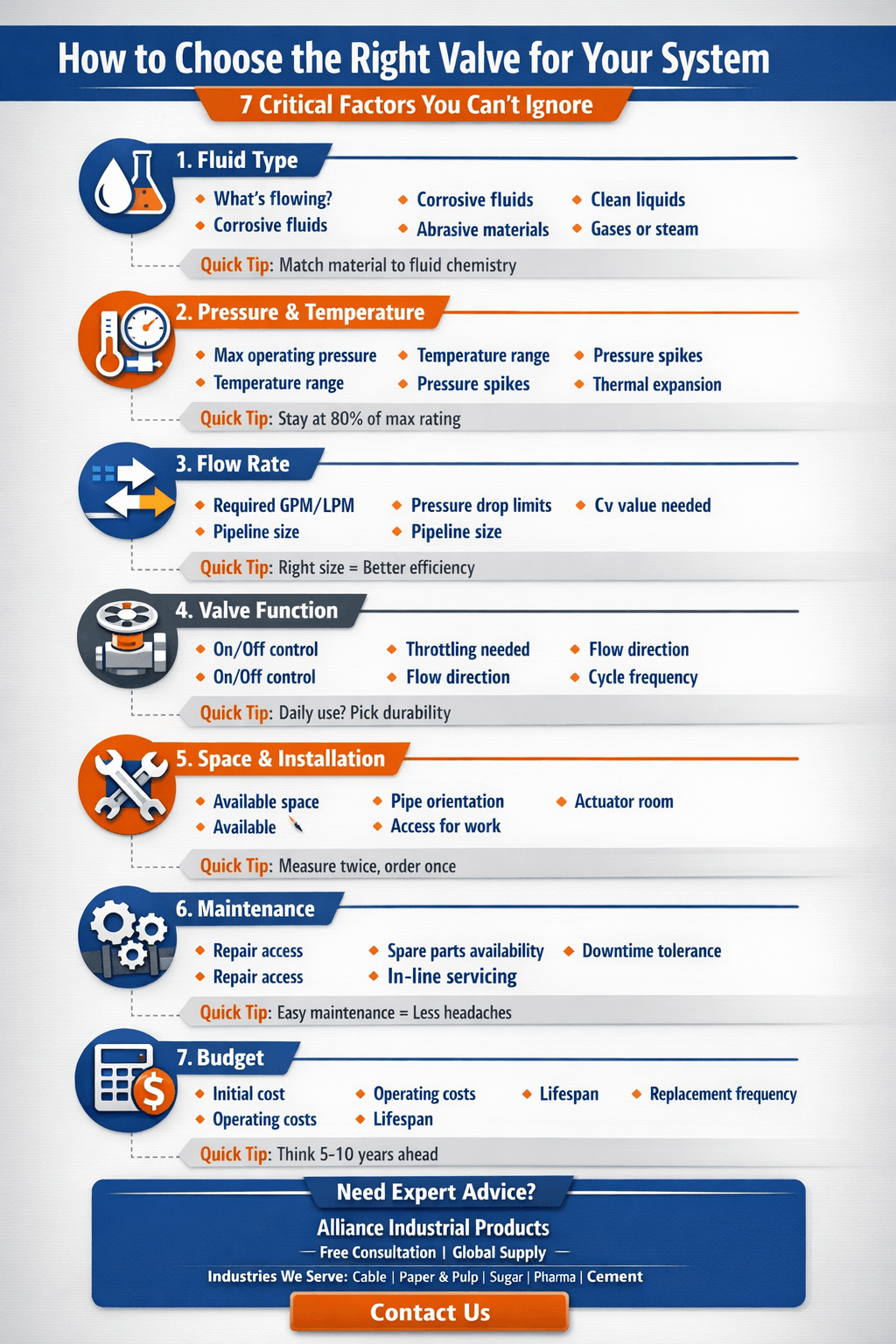
The main criteria include fluid compatibility, pressure and temperature ratings, flow requirements, operating frequency, installation space, maintenance needs, and total cost of ownership.
Key Selection Factors:
- Fluid Compatibility – Different fluids need different materials. Corrosive chemicals destroy valves made for clean water. Abrasive slurries wear down soft materials quickly.
- • Pressure and Temperature Ratings – Your valve must handle normal operations plus unexpected spikes. Running at 80% of the maximum rating gives you breathing room when things get intense.
- Flow Requirements – Calculate your flow rate and how much pressure drop you can accept. Too big wastes money. Too small creates problems downstream.
- Operating Frequency – Do you cycle this valve daily or monthly? Frequent use means you need tough seat materials. Occasional use means focus on reliability when you actually need it.
- Installation Space – Tight spots? Go with quarter-turn valves like ball or butterfly types. Have room? Gate valves give you better control for certain jobs.
- Maintenance Access – Can your team actually get to this valve when something goes wrong? Some designs force you to shut down everything. Others let you work on them while the system runs.
- Total Cost – A cheap valve that fails every year costs more than a good one that lasts. Do the math over 5-10 years, not just the initial invoice.
Global Standards for Valves:
Some key standards that industrial valves must meet are:
- API (American Petroleum Institute): Governs valve design, testing, and performance for oil and gas industries.
- ASME (American Society of Mechanical Engineers): Defines pressure ratings, dimensions, and safety features for various industrial applications.
- AWWA (American Water Works Association): Focuses on water supply valves, ensuring efficiency in municipal and industrial applications.
- ISO (International Organization for Standardization): Provides universal quality benchmarks to maintain consistency across industries.
- BS (British Standards): Specifies manufacturing and performance requirements for valves used in critical applications.
Function of Actuators in Valve Operations:
Actuators help in automating valve operation, improving efficiency, and reducing manual intervention. The three main types of actuators which the Top Industrial Valve Suppliers in India use are:
- Pneumatic Actuators: Use compressed air to open or close valves quickly, making them ideal for fast-response applications.
- Electric Actuators: Provide precise and programmable control, suitable for automated systems requiring high accuracy.
- Hydraulic Actuators: Utilize pressurized fluids for heavy-duty operations, making them ideal for high-pressure applications in industrial settings.
Need Help Picking the Right Valve?
Alliance Industrial Products supplies industrial valves to clients in Oman, South Africa, Kenya, Saudi Arabia, and Australia and many more countries. We’ll talk through your setup before you buy and point you to what actually works for your situation.
We work a lot with Cable, Paper and Pulp, Sugar, Pharma, and Cement industries. Each one has its own headaches, and we know them well enough to skip the generic advice.
Reach out if you want someone to walk through your valve selection with you.

